Since 1 October 2026, suppliers using GeBIZ, Singapore’s government procurement portal, can consider new tenders beyond their registered Supply Head. A Supply Head is the category of goods or services a supplier selected when registering. Where a tender specifies Government Supplier Registration (GSR) as an evaluation criterion, a valid financial grade at or above the stated minimum meets that criterion. Suppliers must also meet the agency’s other mandatory requirements.
The Transition Dates
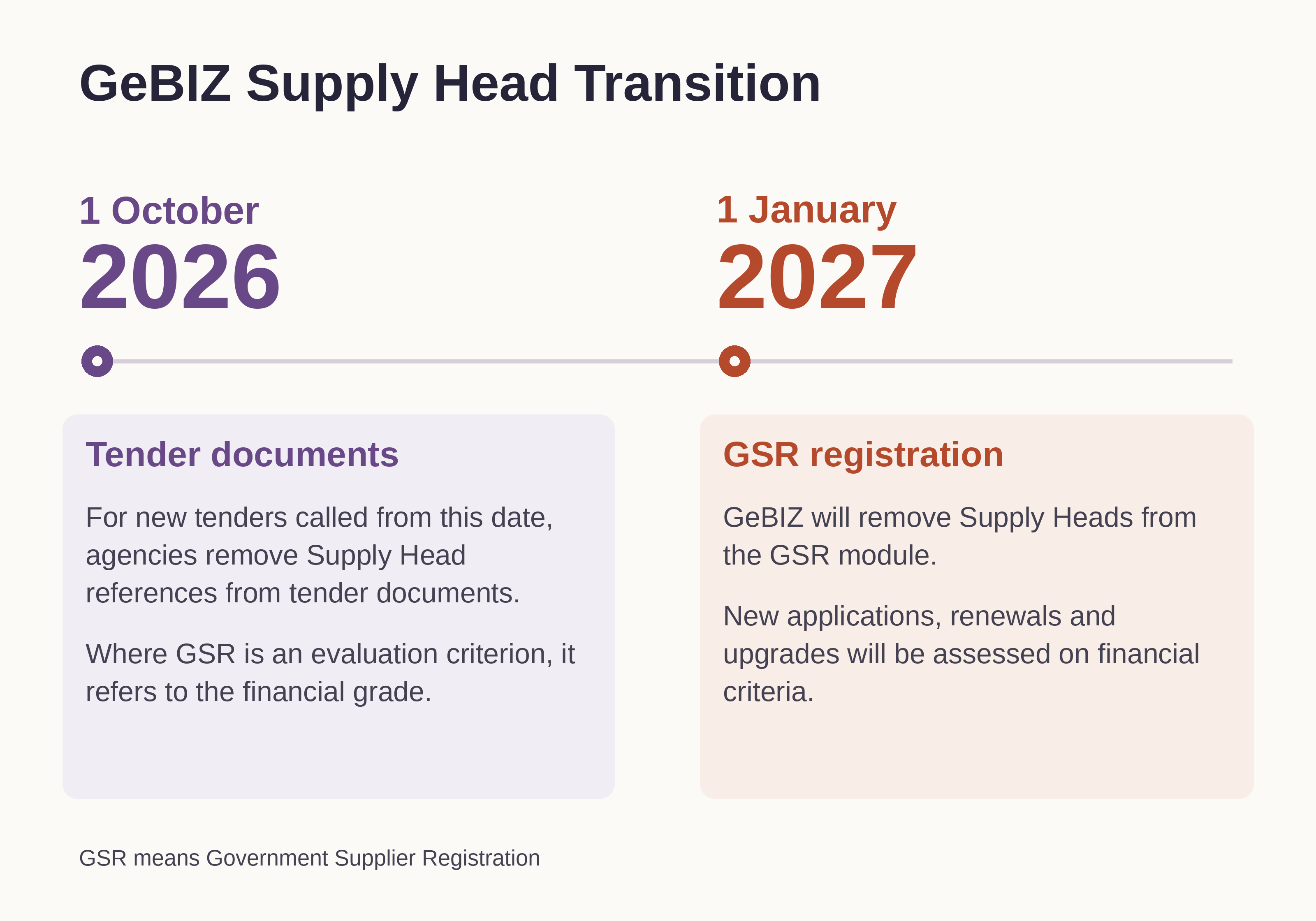
From 1 October to 31 December 2026, existing holders with valid GSR can use their grade for new tenders across categories without applying for additional Supply Heads. New applicants may select any category while the form still requires a selection. For tenders called before 1 October, check the original tender conditions and any amendments.
How To Read An S7 Registration
EPU/SER/34 is the legacy Supply Head for Consultancy Services. S7 is the financial grade.
Tendering capacity reference for S7
GeBIZ lists S$5 million as the Estimated Tendering Capacity for S7. An agency may award a contract above that amount if the supplier meets the tender’s required grade and other award criteria.
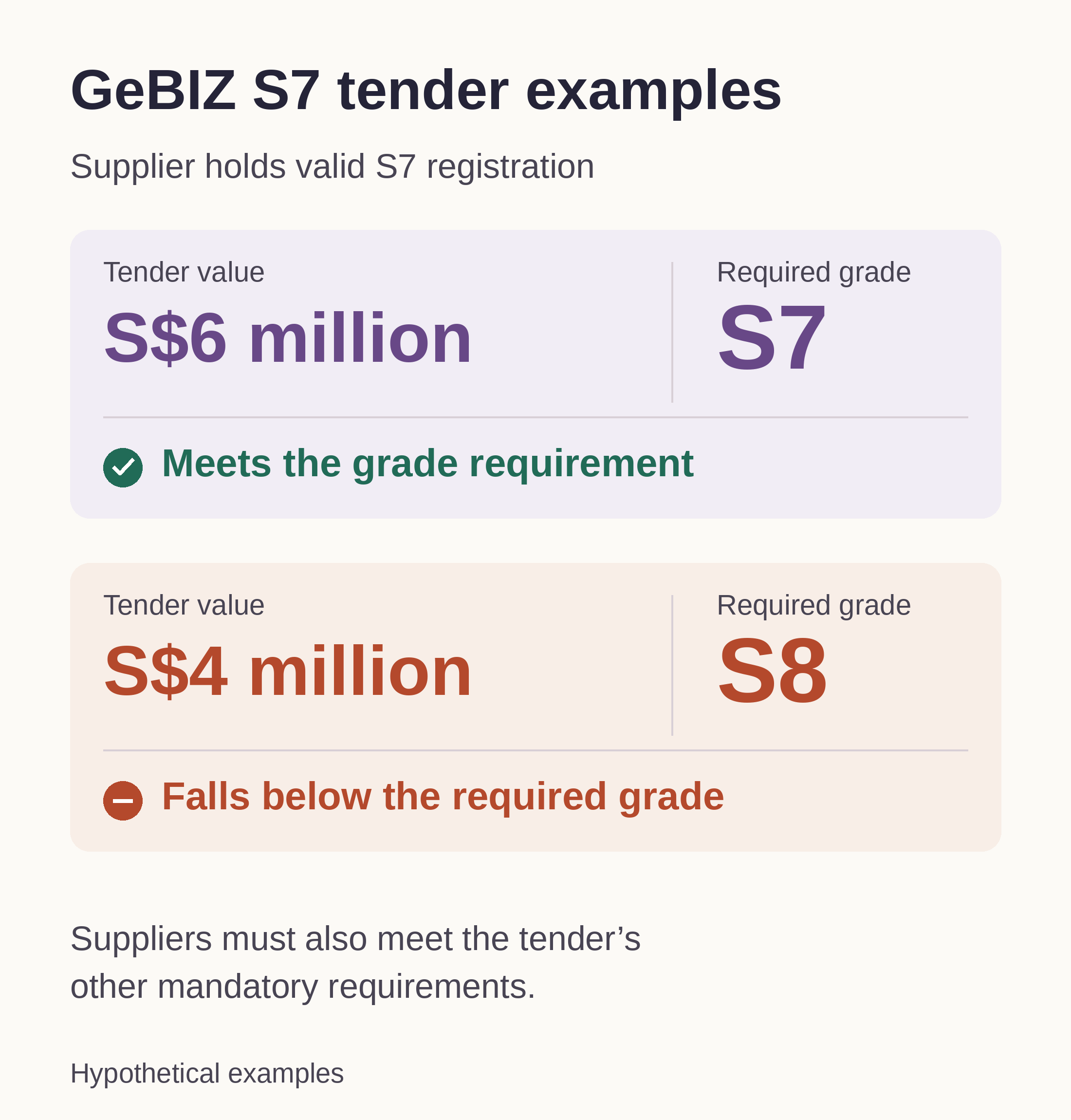
For example, valid S7 registration meets the grade requirement for a hypothetical S$6 million tender that specifies S7. The same supplier falls short of the grade requirement for a S$4 million tender that specifies S8 as mandatory.
Standard Annual Turnover Threshold For S7
For an S7 application, the standard thresholds are S$5 million in annual turnover, sales or revenue and S$250,000 in net tangible assets (NTA). Applicants whose turnover falls below the S7 threshold may qualify under the guidelines if their NTA meets the S$500,000 S8 threshold.
Paid-up Capital Changes For S9 And S10
On 1 January 2027, GeBIZ will remove the separate minimum paid-up capital requirement for S9 and S10. The minimums through 31 December 2026 are S$1.5 million for S9 and S$2 million for S10. This can help firms with sufficient retained profits and lower paid-up capital qualify if they meet the applicable financial criteria. GeBIZ’s NTA calculation for companies includes paid-up capital, reserves and retained earnings.
If the current paid-up capital minimum is holding back your application or upgrade, apply once the change takes effect. The Ministry of Finance plans to update the GSR guidelines by 1 January 2027.
What To Check Before Bidding
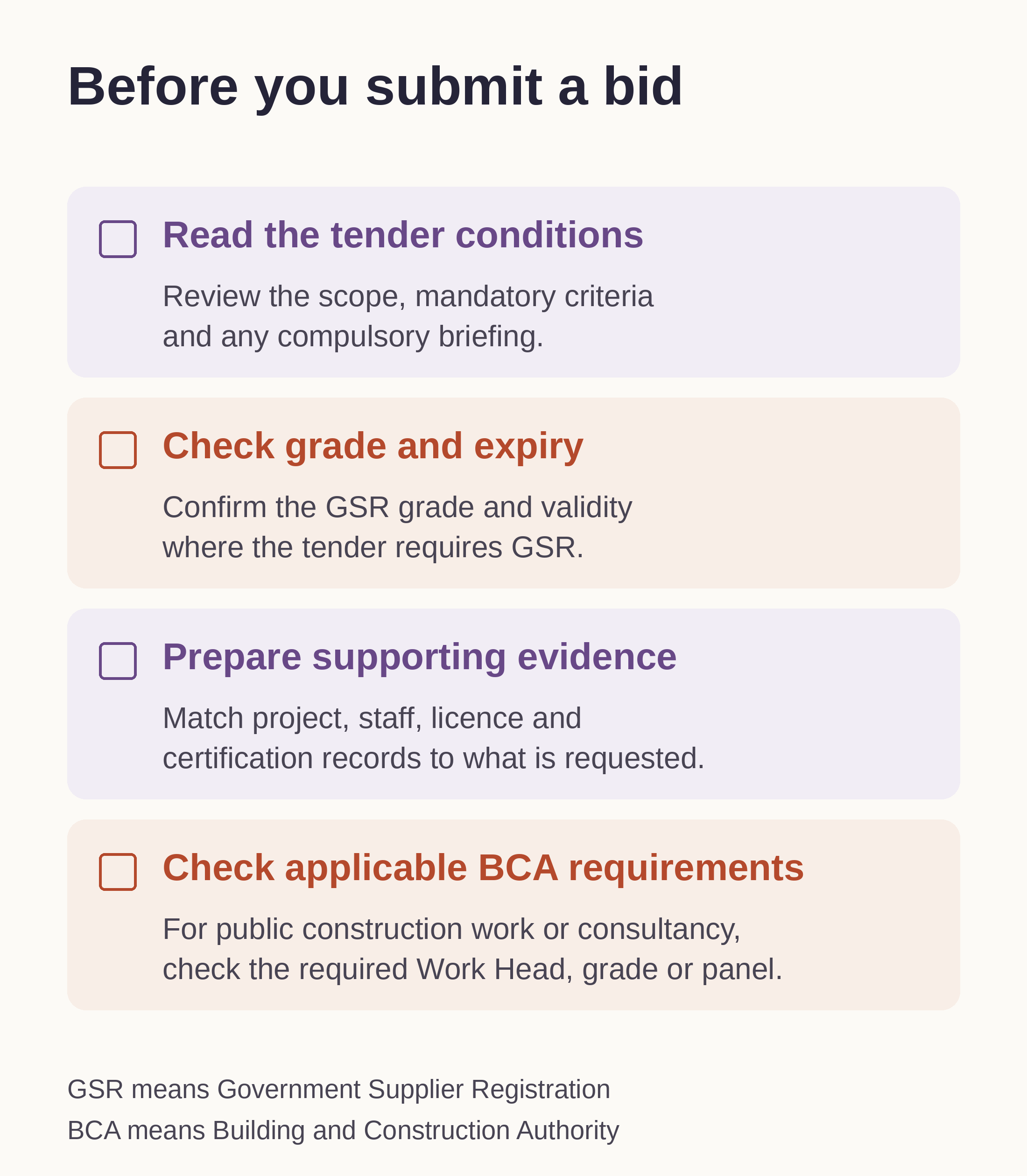
• Read the notice and tender documents. Look for the minimum grade and whether GSR is a mandatory criterion. A GeBIZ Trading Partner account lets you respond on the portal. GSR is a separate registration that agencies may specify for particular tenders.
• Check your grade and expiry. Confirm that your GSR status will be valid when the tender requires it. Allow time for approval if you need a renewal or a grade upgrade.
• Review the scope and the evidence requested. Depending on the tender, you may need to show relevant projects, qualified staff, a licence or a certification. Check any mandatory briefing. If a notice still shows a Supply Head and the tender documents are unclear, ask the issuing agency to confirm the requirement.
• Check the BCA requirements for public construction projects. Construction contractors must check the specified Building and Construction Authority (BCA) Work Head and grade. For consultancy on public construction projects, check the relevant discipline and panel under BCA’s Public Sector Panels of Consultants.
Start with services your team can deliver. A consultancy might search GeBIZ for risk assessments or process reviews, then use the tender’s scope, grade and evidence requirements to decide which opportunities to pursue.
How QuESH Consultants Can Help
When a tender asks for evidence of quality management, workplace safety or information security, QuESH Consultants can help you review the procedures and records your team already has. For example, we can check whether your risk assessments cover the proposed work and identify gaps in the internal audit records you plan to submit.
Official Sources:
1. GeBIZ announcement on the GSR framework, 1 September 2026
2. Ministry of Finance procurement processes
3. GeBIZ GSR registration guidelines, section 9 and appendices A and B
4. Ministry of Finance guide for suppliers
5. BCA Contractors Registration System
6. BCA Public Sector Panels of Consultants