If you run a smaller SME with just one office or site and your environmental impact is pretty straightforward, you can expect to budget around S$6,000 to S$8,000 in direct, first-year costs to get the ball rolling and secure the certificate.
However, keep in mind that the real investment will likely be higher. You also have to factor in your team's time, training, upgrades to your operations, and making sure you are legally compliant with local environmental laws.
Ultimately, your final bill depends on a few things: how big your company is, your industry, how many locations you have, your current setups, and how much hands-on help you need from a consultant.
Breaking Down the Costs: What Are You Actually Paying For?
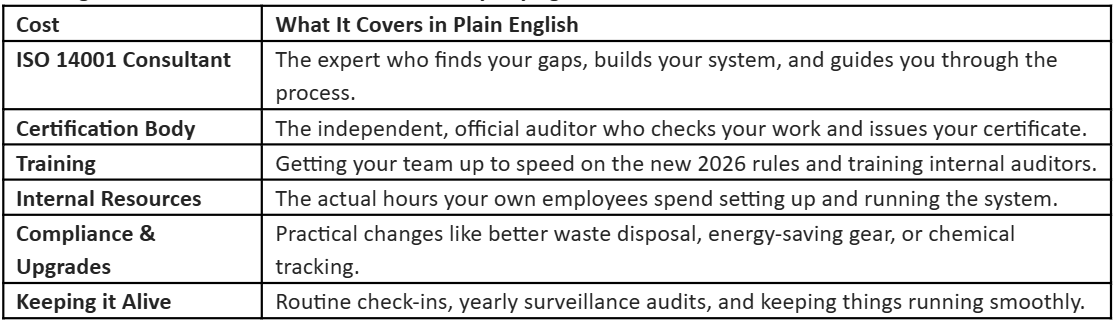
Because of all these moving parts, looking only at a consultant's quote won't give you the full picture of your total investment.
Why Do Prices Vary So Much? (The Reality Check)
Think about it this way:
A professional services firm working out of a standard office building in Raffles Place mostly just needs to manage electricity use, paper recycling, and everyday office waste.
On the flip side, a precision engineering or manufacturing shop operating in a JTC flatted factory in Tuas has to deal with chemical management, hazardous toxic waste, industrial wastewater, emissions, and emergency spill plans.
Both companies can get the exact same ISO 14001:2026 certificate, but the factory is going to spend a lot more time and money to get there. They have to comply with strict National Environment Agency (NEA) Regulations on Toxic Industrial Waste and the Environmental Protection and Management Act (EPMA). The biggest price driver isn't just how many employees you have—it’s how complex your environmental footprint is and how organized you already are.

Consultant vs. Certification Body: Who Does What?
It helps to know the difference between the two main entities you will pay:
- The Consultant: Think of them as your coach. They help you build your Environmental Management System (EMS), write the paperwork, train your team, and get you ready for the big test.
- The Certification Body: They are the exam invigilators. They are independent auditors (like SAC-accredited bodies) who come in, review your system, and—if you pass—hand over the official certificate.
When you are shopping around for consultant quotes, don't just look at the bottom line. Make sure their price explicitly covers:
- Initial gap analysis
- Assessing your environmental risks and impacts
- Mapping out your legal requirements (e.g. EHS Legal Register)
- Writing your EMS paperwork
- Team training
- Internal audit prep
- Support during management reviews
Going for the cheapest quote can backfire if they leave 80% of the heavy lifting to your already-busy employees.
What’s the Deal with the New ISO 14001:2026 Update?
The ISO 14001 standard was updated in April 2026 and is now the official current version.
If you are starting fresh, you should definitely build your system around the 2026 version right from day one. Speak to your consultant and auditor to ensure you are on the right track.
If you are already certified under the older 2015 version, your transition cost will depend entirely on how healthy your current system is. If you already have a mature, active system, updating it to meet the new 2026 focus areas (like climate change risks and biodiversity mandates) should be relatively painless. But if your old ISO system is just a dusty folder on a shelf that nobody looks at, expect to invest a bit more time and money to bring it up to speed.
Note: All Singapore businesses certified under the old standard must transition to the 2026 version by April 2029
Pro tip: Upgrading an existing system isn't the same as starting from scratch, so don't let anyone quote you full price if you already have a strong foundation!
Smart Ways for SMEs to Keep Costs Down
You don’t have to break the bank to get certified. Here are a few practical ways to save money:
1. Do a quick health check first: Figure out what you are already doing right so you don't pay someone to reinvent the wheel.
2. Combine your systems: If you already have ISO 9001 (Quality) or ISO 45001 (Safety), blend your environmental management right into them. It saves massive amounts of paperwork.
3. Appoint an internal champion: Pick a passionate staff member to lead the project. Building this capability in-house saves on long-term consultant fees.
4. Keep it practical: Focus on the environmental issues that actually matter to your business. Don't create complicated processes just for the sake of it.
5. Separate your quotes: Keep consultant fees and auditing fees completely separate so you can negotiate better.
Is It Actually Worth the Money?
For most Singapore SMEs, this isn't just about a badge for your website. It's a strategic business move. Under the Singapore Green Plan 2030, government agencies (like BCA, HDB, or JTC) and large multinational corporations (MNCs) are heavily weighting sustainability scoring criteria in major public and private tenders. Having ISO 14001 ensures you don't get locked out of these lucrative vendor pools.
So instead of asking: "How much will this cost us?"
The better question is:"What kind of value will this bring to our business, and how do we achieve it efficiently?"
The Bottom Line
For an average, straightforward Singapore SME, expect a realistic starting budget of S$6,000 to S$8,000 in direct first-year costs. Just remember to factor in a bit of a buffer for your team's time and any physical upgrades your business might need to make.
Before signing on the dotted line with an ISO 14001 consultant in Singapore, ask them for a completely transparent breakdown of what is included, what is excluded, and what external audit fees to expect.
A great consultant won't just sell you a certificate—they will help you build a practical system that makes your business cleaner, greener, and more efficient for the long run.
Let’s Build a Green System That Actually Works for Your Business
Reading about budgets and frameworks is a great start, but we know what you are probably thinking right now: Where do we even begin? How do we find the time to do this without disrupting our daily operations?
That is exactly where we come in.
We specialize in helping Singapore SMEs navigate the entire ISO 14001:2026 process without the headache. We don’t believe in over-complicating things or handing you a mountain of useless paperwork. Instead, we work right alongside your team to build a practical, lightweight Environmental Management System tailored specifically to your unique business footprint—whether you are running a corporate office or managing a busy facility in Tuas.
From identifying your exact legal gaps to prepping your team for the final audit, we handle the heavy lifting so you can stay focused on growing your business.
Ready to get a clear, no-obligation picture of your path to certification?
Contact our team today to schedule a quick, friendly introductory call. Let’s map out a practical timeline and budget that works for your SME!